
Find out if you need to rethink your daily sandwich or sushi roll.
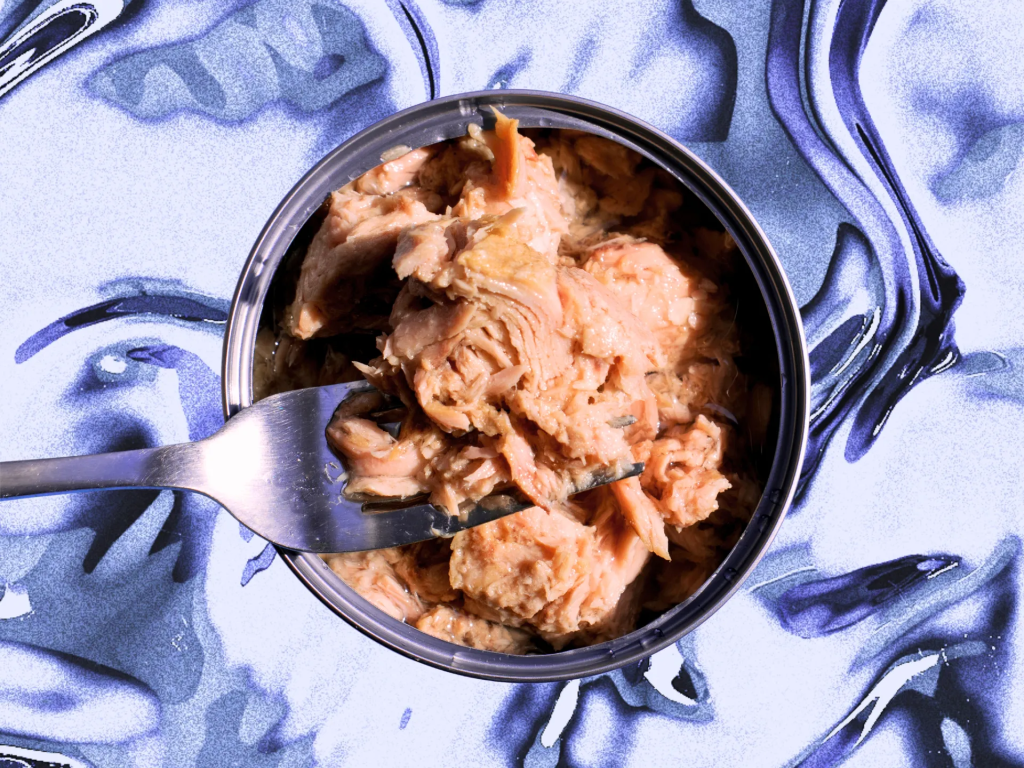
Tuna is awash in helpful nutrients like iron and omega-3 fatty acids—not to mention delicious in sushi, salads, and sandwiches—but it is also known for one ingredient that’s not so beneficial: mercury. That means with every bite of bigeye steak, you might be ingesting a tiny little bit of that naturally occurring heavy metal too.
Sounds scary, but what does this really mean for your health? Could eating a spicy tuna roll for lunch once a week actually come with safety hazards? How about every day? Basically, how worried should you really be about mercury in tuna?
We reached out to a few experts to learn more—and hopefully net (sorry) some answers. Here’s everything you need to know about mercury in tuna before committing to that recurring poke bowl lunch.
How does mercury get into tuna in the first place?
Two words: the food chain. But we’ll start at the beginning.
Mercury is released into the environment by way of both natural events (like volcanic eruptions) and human activity (like coal burning and gold mining). When mercury reaches an aquatic environment, microorganisms like sulfate-reducing bacteria often convert it into a more toxic form of the element known as methylmercury. Then, single-celled algae known as phytoplankton absorb it.
From there, the food chain kicks in. Phytoplankton (the lowest rung) are eaten by small animals known as zooplankton, zooplankton are eaten by small fish, small fish are eaten by bigger fish, and so on—until the buck stops at apex predators like sharks, marlin, swordfish, and, yes, tuna. With each step, the total amount of mercury builds, so these predators can accumulate a lot by the time they’re caught, killed, and processed for food. “Basically, the mercury gets more concentrated” the farther up you go, Vincci Tsui, RD, a certified intuitive eating counselor based in Canada, tells SELF.
Then, the chain continues—with us. Eating fish containing methylmercury is actually the most common mercury exposure route in the US, per the EPA.
Does all tuna contain mercury?
Realistically, yes (in fact, pretty much all fish and shellfish do), but the amount can vary widely.
While many different tuna species exist, five account for the majority of commercial tuna products: albacore, bigeye, bluefin, skipjack, and yellowfin. Some of those species, like skipjack, are smaller, lower on the food chain, and “actually not high in mercury at all,” Tsui says. Others, like bluefin and bigeye, are bigger, higher on the food chain, and thus higher in mercury. Because of these size differences, tuna products made from smaller species like skipjack tend to be less mercury-heavy (and safer to eat), while products made from larger species like bigeye or bluefin lean in the opposite direction. Meanwhile, albacore and yellowfin will fall somewhere in between. Per the FDA, here’s the breakdown of the average mercury content for a few types:
- Canned light tuna (including skipjack): 0.13 parts per million (ppm) or micrograms per gram
- Canned albacore (white) tuna: 0.35 ppm
- Yellowfin tuna: 0.35 ppm
- Fresh or frozen albacore (white) tuna: 0.36 ppm
- Bigeye tuna: 0.69 ppm
So how do you ID the type of tuna you’re chowing down on? In many cases, the product itself is a clue (if the label doesn’t already say). Most light canned tuna is made from skipjack or other small tuna species, for example, Van Eck says. By comparison, many tuna fillets are made from yellowfin, and much tuna sashimi from bigeye. From that info, we can infer that canned light tuna is probably a better bet than a tuna steak, sushi, or sashimi if mercury intake is a concern. “When I am talking to pregnant women,” Van Eck adds, “I’m like, ‘It’s really good to eat fish, have the tuna sandwiches, but probably avoid the sushi.’” Just watch out for cans labeled “gourmet” or “tonno,” according to the Environmental Defense Fund—those often signify that the tuna is yellowfin rather than skipjack, and higher in mercury as a result.
What are the risks of mercury in tuna, and who is especially vulnerable?
Mercury is a neurotoxin, so it can affect your brain and nervous system, along with other body parts like the liver and kidneys. That said, the effects can vary depending on a range of factors, according to the EPA, including:
- The form of mercury (for example, methylmercury—the kind found in tuna—versus metallic mercury)
- The amount of mercury (if the dose is high enough, you can die from mercury poisoning, Tsui says)
- The age of the person
- The duration of exposure
- The type of exposure (breathing, eating, skin contact, etc.)
- The health of the person
In adults, signs of poisoning can include pins and needles sensations (typically in your hands, feet, and around your mouth); loss of coordination; loss of peripheral vision; speech, hearing, and walking impairments; and muscle weakness, according to the EPA. Mercury overload has also been linked to cardiovascular disease, since heart rhythm and function fall under the control of your autonomic nervous system, per research in the International Journal of Environmental Research and Public Health.
While anyone can develop mercury poisoning if they take in too much, fetuses, infants, and kids are among those most vulnerable because their brains and nervous systems are still developing. What’s more, the impact may be irreversible: “This is one of those things where the damage is done,” Van Eck says. In 2016, the National Resources Defense Council estimated that as many as 265,000 babies born in the United States every year are at increased risk of learning disabilities due to prenatal mercury exposure. For that reason, pregnant and breastfeeding people in particular will “want to be conscious” of their mercury intake, Tsui says.
What’s more, the risks associated with excessive mercury intake are different for adults than young kids. When it comes to adults, the main health concern surrounding excessive mercury intake is cardiovascular disease, Elsie Sunderland, PhD, a professor of environmental chemistry at Harvard University who conducts research on mercury and other pollutants, tells SELF. Think an increased risk of high blood pressure, heart disease, and heart attack. With kids, it’s severe birth defects like deafness, blindness, and cerebral palsy at high doses, and widespread neurological deficits like reduced intelligence, shortened attention span, and memory problems at lower doses, since mercury can cause abnormal brain development.
How much mercury is a health concern?
While the FDA and the EPA haven’t published much guidance about recommended mercury intake for the general population, they do offer recommendations for high-risk groups like pregnant and breastfeeding people, people who could become pregnant or start breastfeeding, and young children, so we’ll start there.
For reference, the FDA divides fish into three categories based on their average mercury content: Best Choices (or fish that contain less than or equal to 0.15 micrograms of mercury per gram, like skipjack), Good Choices (fish that contain more than 0.15 micrograms of mercury per gram, all the way up to 0.46 micrograms per gram, like albacore and yellowfin), and Choices to Avoid (or fish that contain more than 0.46 micrograms of mercury per gram, like bigeye).
Two things to keep in mind: One, that these recs are meant for high-risk groups, not the general population. And two, these reference numbers “are averages, and sometimes they’re very highly variable,” Dr. Sunderland says. “You can get a bluefin tuna that’s not that high in mercury, and you can get a bluefin tuna that’s crazy high in mercury, and you can get an albacore tuna that’s relatively low.”
With that said, here’s some guidance to consider for more vulnerable people:
Pregnancy and breastfeeding
Two-to-three servings of canned light tuna (or around 8 to 12 ounces) per week is fine, according to the FDA’s chart. If you’re going with albacore or yellowfin instead, you’ll want to stick to one four-ounce serving per week—and not eat any other fish during that period. Similarly, the American College of Obstetricians and Gynecologists (ACOG) recommends limiting albacore to six ounces per week. And bigeye tuna should be avoided, according to guidance from both the FDA and ACOG.
Childhood
Children ages one to 11 can have two servings of skipjack or another canned light tuna per week, according to the FDA chart. Keep in mind that recommended serving sizes vary by age: one ounce for kids ages one to three, two ounces for kids ages four to seven, three ounces for kids ages eight to ten, and four ounces for 11-year-olds. Other tuna species like albacore, yellowfin, and bigeye appear to be off-limits, according to the chart.
With that in mind, how often is too often to eat tuna for most of us?
Even though the recs above are specifically targeted at high-risk populations, Dr. Sunderland says that they can still apply to the average Joe or Jane. “Typically, we use that for everyone in this country,” she says.
To give an overall recap: Low-mercury tuna like skipjack? “You can have them as much as you want,” Van Eck says. “That’s probably okay to eat every day,” Dr. Sunderland elaborates. Middle-of-the pack tuna options like albacore and yellowfin? “You could eat that weekly, but not every day,” Van Eck says. Try sticking to once or twice a week, max, according to Dr. Sunderland. And when it comes to high-mercury tuna like bigeye, you can have it as an occasional treat, but definitely try to avoid making or ordering it on the regular. “You want to have it rarely, if ever,” Van Eck says. Once in a while is okay, but it’s definitely “not great to eat every day,” Dr. Sunderland adds.
Still, even within the general population, mercury intake recommendations will vary from person to person based on characteristics like age, gender, and body weight. “You really want to think about, ‘Who am I?,’” Dr. Sunderland advises. Body weight will dilute how much you eat, for instance, according to Dr. Sunderland, so larger people can probably have a bit more tuna than smaller people. Similarly, folks planning to become pregnant and small children may want to avoid eating even low-mercury tuna like skipjack on a daily basis, she says, “just because we know that any exposure to mercury does affect cognitive function even at low levels.”
Basically, eating tuna isn’t inherently bad for you (as long as you’re sticking roughly to these general guidelines), but the potential mercury content is something to take into consideration as you’re making dietary choices, especially if you belong to a higher-risk population. Objectively, it’s still preferable to eat low-mercury Northern European fish like herring, pollock, hake, or sardines, according to Dr. Sunderland. “From a nutritional perspective, those are better for you,” she says.